Stories of Puiforcat: The Silver That Outlasted a Century
A Family, a Maison, a Legacy
In 1820, in the workshop-lined streets of the Marais district, two families—the Fuchs and the Puiforcat—joined forces to establish what would become France’s most celebrated silver house. What began as a modest cutlery workshop became, through four generations of artisan obsession, an institution that counts the Louvre, the Metropolitan Museum of Art, and the Victoria & Albert Museum among its admirers.
Over two centuries of silversmithing in Paris have shaped more than tableware—they have shaped a philosophy: that the objects we use every day deserve to be beautiful, precise, and made to endure. This exploration of Puiforcat silver offers a closer look at how form, function, and craftsmanship come together across collections.
A Philosophy Cast in Silver
On Jean Puiforcat & the Art Deco Legacy
To understand Puiforcat is to understand Jean Elysée Puiforcat—the silversmith-sculptor who, between the two World Wars, took a respected family business and placed it firmly at the center of the international avant-garde. Miller’s Antiques Encyclopedia names him simply the “most important French Art Deco silversmith.” It is a title earned not through volume, but through vision.
Having trained in London and studied sculpture under Louis-Aimé Lejeune, Puiforcat emerged from the First World War with a determination to strip ornament back to its essence. In a field dominated by over-worked surfaces and decorative excess, he introduced a radical idea: that a silver object could be beautiful through the discipline of its proportions alone. His pieces were based on geometric series, their surfaces smooth, their volumes precise. He was fascinated by mathematics and applied that fascination to silver in the same way an architect applies it to stone.
In 1929, alongside René Herbst, Le Corbusier, Charlotte Perriand, and Pierre Chareau, he co-founded the Union des Artistes Modernes—a declaration that craft and modernism were not opposites, but natural partners. His work entered the collections of the Metropolitan Museum of Art in New York as early as 1926. The Louvre, the Cooper-Hewitt, and the Victoria & Albert Museum followed. His pieces incorporating lapis lazuli, rosewood, and rock crystal once drew the admiring eye of Andy Warhol, whose collection of Puiforcat silverware sold at Sotheby’s in 1988 for $451,000.
Since joining the Hermès group in 1993, Puiforcat has continued to honor this legacy with a rare kind of integrity: not by preserving it under glass, but by putting it to work. Jean Puiforcat’s forms—architectural, precise, made to last—remain as compelling today as they were a century ago, because they were never really of their time. They were built for every time.
This philosophy comes into focus through two collections—each offering a distinct expression of how Puiforcat shapes life at the table.
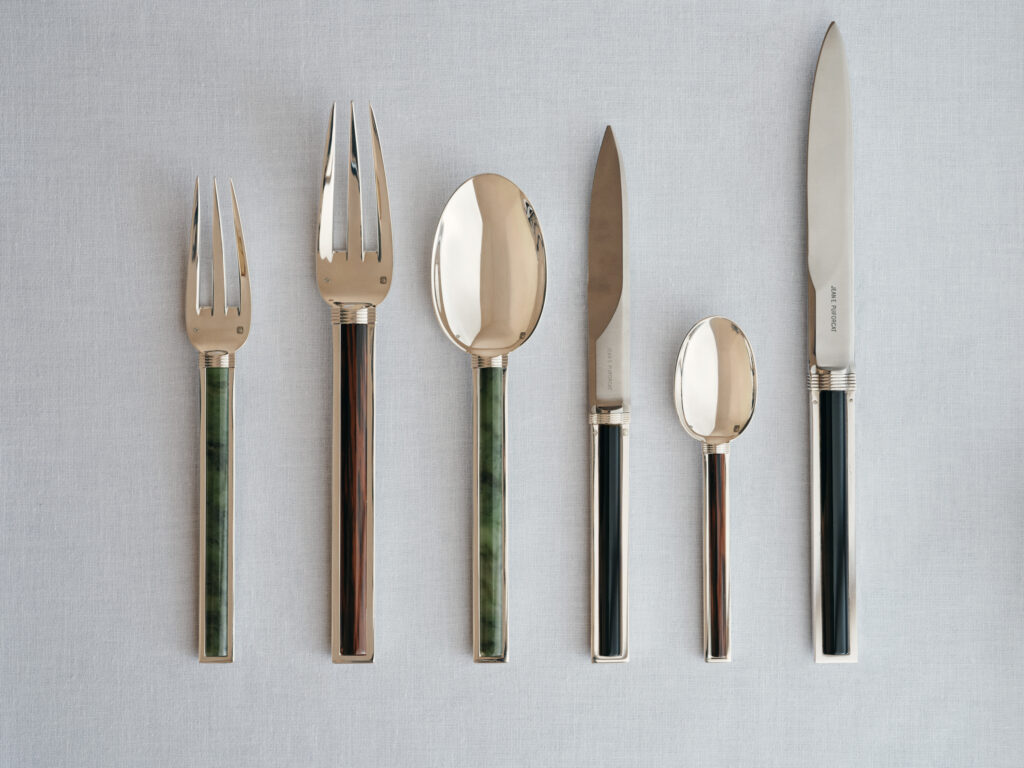
The Cannes Collection
Sterling Silver Flatware · Jean Puiforcat, 1928
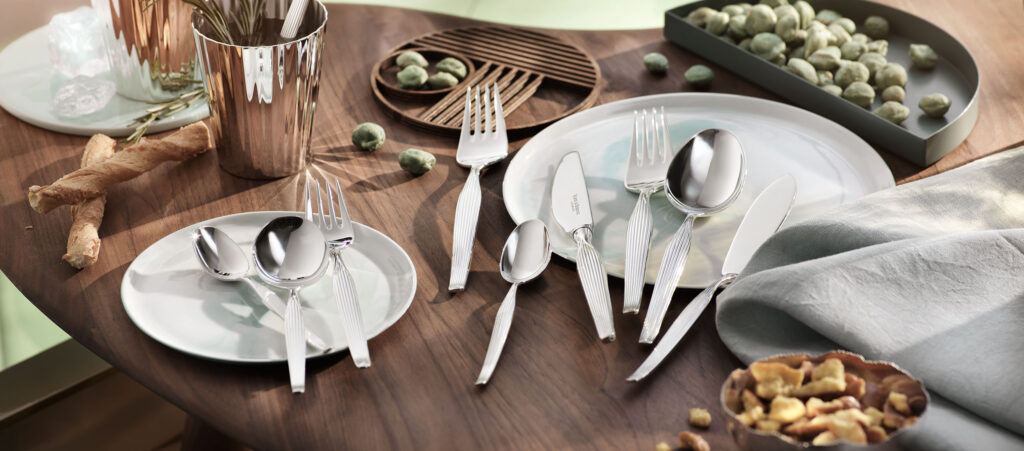
Jean Puiforcat was not only a silversmith. He was a sculptor, a modernist, and a man who believed that form and function were inseparable—that a fork held in the hand should feel as intentional as a building seen from the street. Nowhere is that conviction more evident than in the Cannes collection, created in 1928 and widely regarded as one of the most significant Art Deco flatware designs ever produced.
The inspiration came from an unlikely source: the facade of the Hôtel Martinez in Cannes. Puiforcat, a devoted lover of the French Riviera, was drawn to the hotel’s precise architectural language—its protruding balconies, the disciplined rhythm of its grooved stonework, the way geometric ornament could convey both luxury and restraint. He translated those lines, quite literally, into silver. What emerges is a handle defined by five raised rings at its crown, a fluted body that catches light the way classical columns catch shadow, and an overall profile of such formal purity that the pieces interact like volumes in a sterling silver sculpture.
The collection was personal to Puiforcat in a way that went beyond aesthetics. When he married Maria Estevez, he chose the Cannes flatware for his own wedding table—perhaps the most intimate declaration a designer can make about the objects they create. These were not objects designed for display. They were designed for use, for the intimacy of a shared meal, for a life lived beautifully.
Today, the Cannes collection remains in continuous production, handcrafted in Puiforcat’s Parisian workshop using techniques refined across generations. It is available in classic sterling silver and in a precious Jewelry edition—where the handles are set with onyx, jade, or jasper—a nod to Jean Puiforcat’s well-documented love of combining flawless metalwork with semi-precious stones. Every piece is produced using methods unique to the Paris atelier: planishing—an age-old hand-hammering process—gives the silver its characteristic integrity; a ratchet method forms the stepped geometric decoration with architectural precision; and a multi-stage buffing procedure produces the mirror-like finish that is the Maison’s signature. The result is flatware designed, as Puiforcat always intended, for a table that is actually lived at.
Where Cannes expresses structure and discipline at the table, Puiforcat’s work does not end there—it extends into the atmosphere of the table itself.
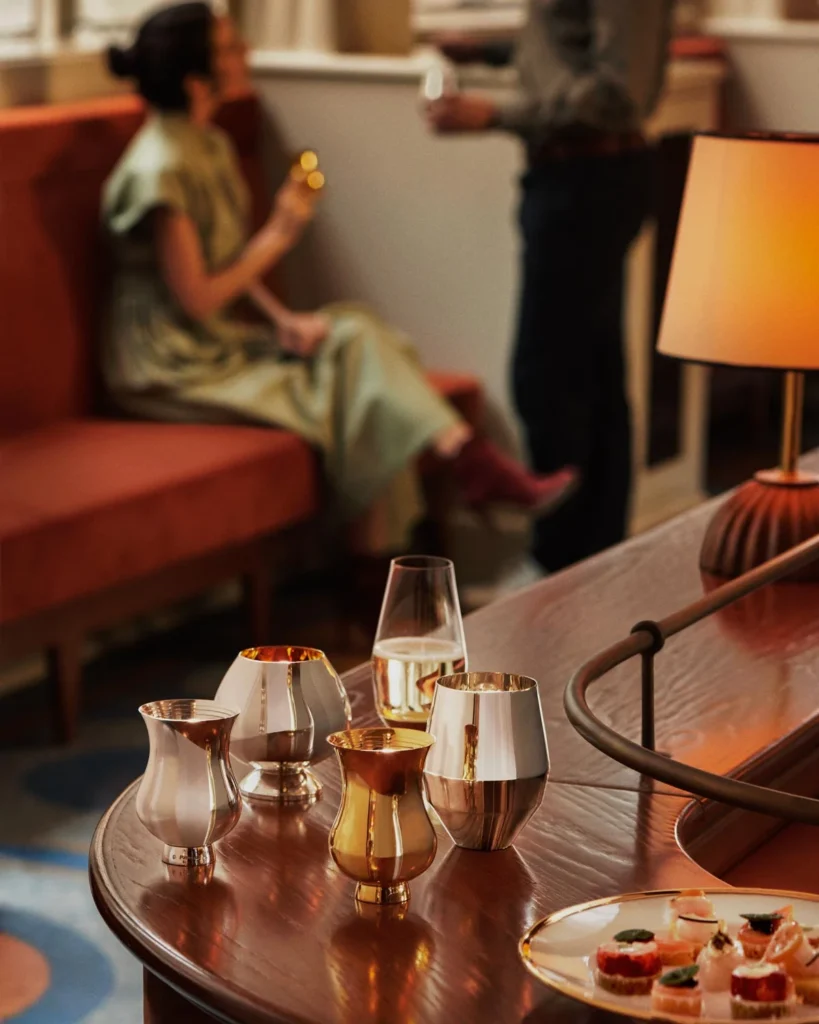
Pour le Champagne
Sterling Silver & Gold Gilt Tumbler · In collaboration with Bruno Paillard
There is a moment, just before the first sip of Champagne, when everything slows. The bottle is open, the table set, and the light in the room catches something and holds it. Puiforcat designed a vessel for exactly that moment.
The Pour le Champagne tumbler was born from a conversation between two worlds: the precision of Puiforcat’s silversmithing and the oenological expertise of Bruno Paillard—winemaker, Champagne house founder, and one of France’s most respected voices on how sparkling wine should be experienced. Together, they approached the question not as a design problem, but as a sensory one: what vessel would honor Champagne at its finest?
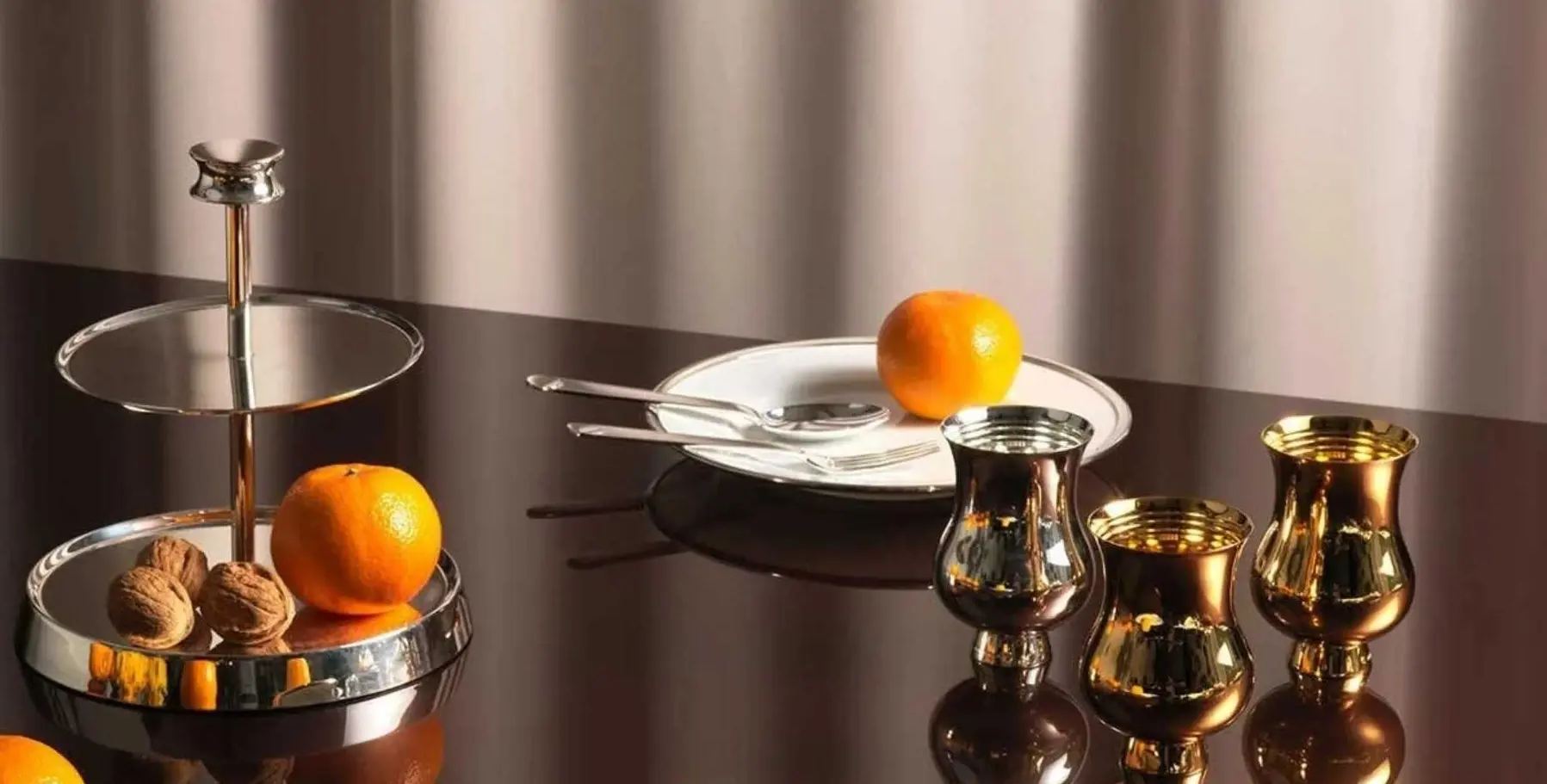
That question drove every decision in the design. The flared rim facilitates tasting. The narrow neck concentrates the wine’s aromas, allowing its character to emerge fully. The generous volume of the base lets the Champagne breathe. And at the very tip of the base, a subtle engineered feature produces what can only be described as a geyser effect—intensifying the aromatic bubbles as they rise, making the effervescence more pronounced, the experience more vivid. Sterling silver, long understood to preserve cold more effectively than glass, keeps the wine perfectly chilled throughout—making it, counterintuitively, the superior vessel for a wine meant to be served at low temperature.
When filled, the delicately engraved interior comes alive. Three engraved lines represent the three grape varieties essential to great Champagne—Chardonnay, Pinot Noir, and Pinot Meunier—a detail so quiet it rewards only those who look closely. The brilliance of the silver mingles with the wine’s color to create a warm, golden light within, as though the tumbler itself is drinking. The footed design lifts it from the table surface, preventing condensation from marking the linen. And it is pleasing against the lips in a way that glass, for all its transparency, is not.
The tumbler is available in two finishes: pure sterling silver, and a gold immersion finish that deepens the warmth of the wine’s reflection within. A matching sterling silver Champagne bucket completes the collection, keeping the bottle perfectly chilled and continuing the mirror-polished play of light that makes Pour le Champagne unlike anything else at the table.
Like Cannes, it represents just one expression within a much broader body of work—one that moves seamlessly between flatware, barware, and sculptural objects for the table.
A Discipline That Endures
The story of Puiforcat is, in the end, a story about conviction—the belief that beauty is not a luxury but a discipline, and that the objects we bring to our tables are worth making with the same rigor we bring to architecture, to sculpture, to anything built to last. Jean Puiforcat understood this a century ago. The Maison he shaped continues to prove it, piece by piece, at every table where his silver is used.
These pieces offer a point of entry, but they are far from the full expression of the house. Puiforcat’s collections extend well beyond what is shown here—each one carrying the same clarity of line, weight of material, and commitment to form that has defined the Maison for generations.






What You Want to Know About Puiforcat
The Cannes collection was designed by Jean Puiforcat in 1928, inspired by the architectural facade of the Hôtel Martinez on the French Riviera. Its defining detail—five raised rings atop a fluted handle—directly mirrors the hotel’s grooved stonework and protruding balconies. Puiforcat held the collection in such personal regard that he chose it for his own wedding table. It remains in continuous production today, handcrafted in Puiforcat’s Parisian atelier.
Jean Elysée Puiforcat (1897–1945) is widely regarded as the most important French Art Deco silversmith. Trained as both a sculptor and a silversmith, he co-founded the Union des Artistes Modernes in 1929 alongside Le Corbusier, Charlotte Perriand, and René Herbst—placing silversmithing at the center of the modernist movement. His work entered the collections of the Metropolitan Museum of Art, the Louvre, and the Victoria & Albert Museum during his lifetime. The geometric language he developed—precise, architectural, stripped of excess ornament—continues to define Puiforcat’s aesthetic today.
Every Puiforcat piece is handcrafted in the Maison’s Paris workshop using techniques refined over two centuries. These include planishing—a hand-hammering process that gives the silver its structural integrity—as well as spinning on a lathe to form rounded objects, brazing to attach components, chasing and etching for surface decoration, and a multi-stage buffing process that produces the Maison’s signature mirror finish.
Puiforcat occupies a singular position in the history of decorative arts—not simply as a silversmith, but as a house that shaped the visual language of an entire design era. Where other silver houses favored elaborate ornamentation, Puiforcat introduced pure geometric form, treating each piece as architecture rather than decoration. That philosophy, combined with over two centuries of unbroken workshop tradition and the stewardship of the Hermès group since 1993, gives the Maison a depth of heritage that is genuinely rare.
Sterling silver preserves cold more effectively than glass, making it the superior material for a wine meant to be served well-chilled. It is also exceptionally pleasing against the lips—a tactile quality glass cannot replicate. Puiforcat’s Pour le Champagne tumbler takes this further: its engraved interior interacts with the light of the wine to produce a warm, luminous glow within the cup, and its precisely engineered base creates a geyser effect that intensifies the effervescence and aromatic character of the Champagne.
Yes. Puiforcat joined the Hermès group in 1993, a partnership that has allowed the Maison to continue its work with the resources and creative vision of one of France’s great luxury houses. Under this stewardship, Puiforcat has collaborated with contemporary designers, reissued treasures from its classical archive, and continued to produce new work that honors the geometric principles Jean Puiforcat established a century ago.
Kneen & Co is an authorized Puiforcat retailer based in Chicago, offering access to the Maison’s full collection—including the Cannes flatware, the Pour le Champagne tumbler and bucket, and additional pieces across flatware, hollowware, and decorative objects. Our team is available for personal consultations, bridal registry guidance, and gift sourcing. Visit us at kneenandco.com or contact us directly for availability and special requests.
Discover Puiforcat at Kneen & Co
As an authorized retailer, we offer access to the Maison’s full collection. From the iconic Cannes flatware to the Pour le Champagne tumbler, our team is here to guide you to the pieces that are right for your table—and your life.